
Immigration Updates
October 2025
Community Alerts
Heightened Targeting of South Asians in Chicago
Over the past several weeks, South Asian community members in Chicago have reported increased scrutiny and harassment based on their ethnicity and appearance, including a recent incident in which ICE agents gave chase to three South Asian individuals walking along Chicago’s lakefront and demanded that they “show their [H-1B] papers.” These incidents come amid a broader surge in immigration enforcement across the city and new federal policies that disproportionately affect our South Asian community.
Most notably, the U.S. government has imposed a $100,000 H-1B visa fee, nearly a 95 percent increase from prior rates, affecting primarily Indian and South Asian professionals who make up nearly 70 percent of H-1B visa holders. This shift, combined with growing anti-immigrant rhetoric and online narratives framing Indian workers as “competitors” reflects a troubling normalization of bias that places our community at heightened risk of discrimination.
(For more, see AAPIs Equity Alliance report at https://aapiequityalliance.org/go-back-to-your-country-the-surge-of-anti-indian-sentiment-on-american-social-media/)
Carrying Proof
Federal law requires non-citizens, including green card holders and non-immigrant visa holders, to carry proof of lawful status at all times, such as a green card, I-94, or valid visa. While this rule has rarely been enforced in the past, there are now reports of individuals being fined for failing to carry documentation.
Given this changing climate, it is essential to stay informed, exercise caution, and know your rights during any encounter with law enforcement or immigration officers.
Recent Court Rulings
Two major federal court decisions have recently sought to curb how immigration enforcement operates in Chicago and surrounding areas. Both rulings place important limits on government authority while reaffirming constitutional protections for all residents, regardless of immigration status.
Background: Every Person in the U.S. Is Protected Under the Fourth Amendment
In the United States, the Fourth Amendment to the U.S. Constitution protects everyone, regardless of immigration status, from unreasonable searches and seizures by government officials. This means the government cannot arrest or detain you, search your home, or take your property without proper legal authority.
Usually, if government authorities want to arrest or stop someone, search their property, or take their possessions, they must first get a warrant signed by a judge. That means they must make the case to a judge that there is probable cause, a specific legal reason, for the arrest or search. Without a judicial warrant, an arrest is allowed only in a few narrow situations, such as when someone is about to escape or when there is an emergency.
ICE (Immigration and Customs Enforcement) is the federal agency that arrests and detains people for immigration violations. ICE is also required to follow the Fourth Amendment of the U.S. Constitution. When ICE arrests or detains someone, they are supposed to have a judicial warrant. However, ICE sometimes tries to use its own paperwork, called an “administrative warrant,” to avoid going before a judge, proving probable cause, and getting the judge to sign a warrant. In this case, ICE prepares a document that looks like a judicial warrant but is not signed by a judge, only by another ICE officer.
ICE has been using these administrative warrants to arrest people both at home and in the community. These arrests include what are called “collateral arrests,” meaning the person arrested was not originally the target of an investigation or the subject of a warrant but happened to be picked up during an enforcement action.
Two major federal court decisions have recently curbed how immigration enforcement operates in Chicago and surrounding areas. Together they limit certain forms of government overreach and shape how enforcement can occur. The Castañon-Nava ruling, in particular, reaffirms that Fourth Amendment protections against unlawful searches and arrests extend to all persons in the United States, including non-citizens. When those protections are not upheld, it raises concerns for everyone, since the same constitutional standards are meant to safeguard all individuals from government intrusion.
Castañon-Nava (Nava) Consent Decree Ruling
The ruling came after a series of raids under “Operation Midway Blitz,” including a high-profile arrest of a family at Millennium Park and reports of racial profiling during enforcement actions across the city. The Court found:
- Administrative warrants ICE uses to arrest people (which are not signed by a judge) are not real warrants. That means arrests based on ICE administrative warrants are actually warrantless arrests.
- ICE can only arrest someone without a judge’s warrant if they have strong reason to believe both that:
- the person is subject to deportation, AND
- the person is likely to run away before ICE has time to get a judicial warrant.
- The Court said that when deciding if someone might run away ICE has to look at real community ties, like whether the person has a home, family, or job. These things show someone is not likely to flee. Moreover, ICE can only base this information on what it actually knows at the time of arrest, not on information discovered later.
- The Court extended these protections through February 2, 2026. That means these same protections against warrantless arrests remain in effect at least until then.
National Guard Ruling
Last week, a federal district judge’s decision stopped the Trump administration from sending 500 National Guard troops into Chicago. A Circuit Court of Appeals panel ruled unanimously on Thursday October 16th to maintain the district court’s block on National Guard deployment in Chicago.
The troops are currently staying at a base near Joliet and are not allowed to enter or patrol the city. While this ruling prevents the National Guard from being used in Chicago neighborhoods, ICE and DHS enforcement teams have continued aggressive operations on the North Side, including reported use of tear gas.
The judge will revisit the issue on October 22 to decide whether to keep blocking the National Guard deployment.
Community Action: Documenting ICE Encounters
Community members with citizenship and protected status are encouraged to document and report any ICE actions that violate these protections, especially arrests without warrants, targeting based on appearance, or the use of threats or intimidation. These reports can strengthen both individual cases and broader legal efforts to challenge ICE’s practices.
If you feel comfortable and safe doing so, you can video record the incident on your phone. If you do so, announce that you are recording. The best practice is to hold your phone horizontally to capture more of the action. Otherwise, you can take notes during the action, and later write up full notes. Include as many of the following details as possible:
- Date and time of the encounter;
- Description of what happened;
- What you said and what the agent said (including any questions asked);
- Identification of agents (names and badge numbers, if available);
- Number of agents present;
- Warrant or legal documents shown, with details such as date, type, and areas authorized to be searched (attach photos if possible);
- Presence of weapons;
- Whether agents blocked exits or restricted movement;
- Any property searched or taken and persons questioned;
- Names of any persons detained;
- How the encounter ended, including any intimidation, threats, or use of force; and
- Names and contact information of witnesses.
Who to contact to report violations:
FAMILY SUPPORT NETWORK AND HOTLINE: 1-855-HELP-MY-FAMILY (1-855-435-7693)
The Illinois Coalition for Immigrant and Refugee Rights (ICIRR) operates this confidential hotline to assist individuals and families impacted by immigration enforcement. Callers can report ICE activity, seek legal or emergency support, and get connected to verified community organizations and attorneys. The hotline is available in multiple languages and can also provide updates on local enforcement actions, information on detainee location, and referrals for family preparedness planning.
If you would like a confidential consultation with an IAC Immigration representative, please contact us at immigration@indoamerican.org or call (773) 973-4444.
April 2025
Recent Immigration Updates Impacting IAC Community
- New Non-Citizen Registration Requirement
- Important Information for International Students: Visa Cancellations and SEVIS Terminations
- Travel in the Current Political Climate: What You Should Know
- IRS Data Sharing with DHS for Immigration Enforcement
Details for each topic outlined below
New Non-Citizen Registration Requirement
At the beginning of 2025, the Trump Administration announced that some immigrants will need to register online and provide their fingerprints to the Department of Homeland Security (DHS).
The Registration Requirement went into effect on April 11, 2025. Those who are required to register have 30 days to do so.
Not all non-citizens need to register through this process. Many non-citizens are already considered registered. However, those considered already registered are still required to carry proof of their registration.
Failure to register may result in criminal penalties and/or fines, as outlined in this document. Non-citizens should consult with a trusted immigration lawyer or DOJ accredited representative for further guidance regarding Registration and its possible consequences.
According to this requirement, who needs to register?
The primary groups of non-citizens that must register using the new process established by DHS are:
- Non-citizens who entered without being inspected by an immigration officer, have not been encountered by DHS, or who do not have work authorization.
- Non-citizens who entered without being inspected by an immigration officer and have applied for certain benefits (including asylum and Temporary Protected Status) but do not have employment authorization documents (work permit), or who have not been issued a Notice to Appear, the document that is issued to begin removal proceedings.
- All non-citizens above the age of 14 who remain in the United States for 30 days or longer.
- Children turning 14 must register and be fingerprinted within 30 days of their birthday, even if they were previously registered.
- Canadian nationals who last entered the U.S. without receiving a Form I-94
Who is considered already registered?
The following groups are considered registered this is not a complete list:
- Green card holders (Lawful Permanent Residents)
- People who were granted parole, including advance parole (even if expired)
- People who came to the U.S. on a nonimmigrant or immigrant visa (even if expired)
- People who are already in immigration removal or deportation proceedings
- People granted employment authorization on any basis (even if expired)
- Refugees
- People who applied for lawful permanent residence (even if application was denied)
- People who have border crossing cards or entered the U.S. as crewman
What are the penalties associated with this requirement?
Penalties vary by violation with fines up to $5,000, jail time, or both for some offenses.
- Willful failure to register: Up to $5,000 fine and/or up to 6 months in jail.
- Not carrying proof of registration:?Up to $5,000 fine and/or up to 30 days in jail.
- Not updating your address with USCIS (a separate form you can file online) within 10 days: Up to $200 fine and/or 30 days in jail.
Fraud in the registration process, such as providing false information, either as a US citizen or non-citizen, could also lead to criminal?consequences.
What could happen if you register?
Registering can show that you are following the rules, which might help with future immigration applications.
It’s important to be honest when you register. Providing false information such as using a fake name or lying about your immigration history can lead to serious consequences. For non-citizens, this could mean being placed in removal proceedings or criminal charges. U.S. citizens could face criminal charges.
If you are undocumented, registering could lead to removal proceedings before an immigration judge. ICE could send you a letter asking you to report to an office, where they may detain you or start removal proceedings. If you cannot prove you?ve been in the U.S. for over two years, you could face expedited removal, a fast-track deportation process with no hearing before a judge unless you have credible fear of torture or persecution.
It’s important to talk to an immigration lawyer or DOJ accredited representative before registering to understand your rights.
What could happen if you don’t register?
If you don’t register, you could face criminal charges. This can happen if you have contact with law enforcement like ICE and they see that you have not registered. (See the question above for more details about possible penalties).
Not registering could also affect your future immigration applications. Immigration benefits are discretionary. This means the government can choose to approve or deny your application based on your history. If you don?t register, it could be used against you later.
Do I need to carry documents to prove I registered?
Yes, you should carry proof of registration. There are different forms of proof based on what makes you considered registered (for example, a Notice to Appear for court, a work authorization card, proof that you have an application for permanent residency).
Once you register through this process online, and you have completed your fingerprints at a USCIS Application Support Center, USCIS will issue you a certificate ?Proof of Alien Registration document found on your online account. This document should be carried with you as proof that you have registered.
Many non-citizens in the United States already have a document that serves as proof of registration like:
- I-94 Arrival-Departure Record
- I-485 Application for Permanent Resident Receipt Notice
- I-590 Registration for Refugee Status
- Green Card (I-551)
- Employment Authorization Document (EAD) (I-766)
- Notice to Appear (I-862)
- Border Crossing Card (I-185, I-186)
Even if you carry this proof, remember, you have the right to remain silent and to talk to a lawyer if you’re stopped or arrested.
Get a Legal Consultation
If you have questions about the Registration Requirement and how it may impact you, call the Indo American Center at (773) 973-4444 or email us at immigration@indoamerican.org. You can also come meet us in person at an upcoming Immigration Law Open House.
- January 08, 2026: 4p – 7p
- January 22, 2026: 4p – 7p
- February 05, 2026: 4p – 7p
- February 12, 2026: 4p – 7p at IAC Des Plaines Location (1118 Lee St, Des Plaines, IL, 60016)
- February 26, 2026: 4p – 7p
March 12, 2026: 4p-7p - March 26, 2026: 4p-7p
- It is important to consult an immigration lawyer or DOJ accredited representative who can advise you on your rights and any potential legal risks.
If you’re at risk of being placed in removal proceedings, an immigration lawyer or DOJ accredited representative can help you understand any options you may have to fight your case and stay in the U.S. For example, if you have been here for more than 10 years, you might be eligible for cancellation of removal based on hardship to certain U.S. citizen or Legal Permanent Resident family members.
There is no cost to register. The only place you can register is through the official USCIS website.
Do not pay anyone to assist you with registering! Instead, seek a legal consultation with a trusted immigration attorney or DOJ accredited representative.
You can find options for free or low-cost legal help below:
- Immigrant Legal Support Program Workshops
- Illinois Access to Justice
- Illinois Coalition for Immigrant and Refugee Rights attorney & nonprofit lists
For more information about your rights related to this policy, visit the National Immigration Law Center. Stay connected to trusted sources for updates.
Important information for international students: Visa cancellations and SEVIS terminations
In recent weeks, the Trump administration has taken new actions affecting international students. Some students have had their visas canceled or their SEVIS (Student and Exchange Visitor Information System) records terminated. These are two different processes and can lead to serious immigration problems.
- Visa Revocation: A visa revocation is issued by the U.S. Department of State and cancels a person’s permission to enter the United States. It does not, by itself, terminate the individual’s ability to remain in the U.S. if they are already here and otherwise maintaining valid status. However, the revoked visa cannot be used for future travel and reentry. Notification of a revocation is typically sent to the email address used in the visa application, but practices have been inconsistent.
Important: If you used an agent or consultant to apply for your visa, the email address used may belong to them not you. You may not receive the revocation notice directly, so check with your consultant if applicable.
- SEVIS Termination: A SEVIS termination ends a student?s lawful F-1 or J-1 status in the U.S. SEVIS (Student and Exchange Visitor Information System) is the federal database used to track international students and scholars. Traditionally, SEVIS records are terminated by a university’s Designated School Officials (DSOs) when a student violates the terms of their status. Recently, however, the Department of Homeland Security (DHS) has begun terminating records directly, without university involvement, effectively ending the student’s status and legal presence.
Check your SEVIS record proactively.
Do not assume your status is intact just because you haven’t been contacted. Some students are discovering their termination only after the fact, with no prior notice from their school or the government.
It is important to understand that two actions can happen separately or together:
- A student may have their visa revoked but still maintain lawful status if their SEVIS record is active.
- A student whose SEVIS record is terminated is out of status, even if their visa stamp has not been revoked.
What You Should Do
If you receive notice that your visa was canceled or learn that your SEVIS record has been terminated call the Indo American Center at (773) 973-4444 or email us at immigration@indoamerican.org.
Travel in the Current Political Climate: What You Should Know
For individuals currently residing in the United States with valid immigration status such as F-1 students, J-1 exchange visitors, H-1B workers, or lawful permanent residents planning international travel during the current political climate requires careful consideration. Recent policy shifts under the Trump administration have introduced heightened risks associated with reentry, even for those with previously secure statuses.
Risks Upon Reentry
Travelers returning to the U.S. may face increased scrutiny at ports of entry. Customs and Border Protection (CBP) officers have been reported to conduct extensive interviews, review social media activity, and, in some cases, detain individuals for further investigation. There are instances where individuals with valid visas or green cards have been denied reentry or subjected to prolonged questioning, especially if their activities or affiliations are deemed politically sensitive.
Recommendations for Travelers
- Assess Necessity of Travel: If international travel is not essential, consider postponing plans until there is greater clarity and stability in immigration policies.
- Legal Consultation: Before traveling, consult with an immigration attorney to understand potential risks and to ensure all documentation is in order.
- Documentation: Carry comprehensive documentation, including proof of legal status, employment or enrollment verification, and any correspondence related to your immigration status.
- Social Media Awareness: Be aware that your online presence may be reviewed. Ensure that your social media accounts do not contain content that could be misinterpreted or deemed controversial by immigration authorities.
- Emergency Contacts: Have contact information for legal counsel and trusted individuals in the U.S. who can assist in case of unexpected issues at the border.
IRS Data Sharing with DHS for Immigration Enforcement
There have been reports that the Internal Revenue Service (IRS) may begin more actively sharing taxpayer information with the Department of Homeland Security (DHS), particularly in connection with immigration enforcement. While tax data is generally protected by federal confidentiality laws, limited exceptions allow for data sharing in specific cases, such as those involving national security or criminal investigations.
Recent reporting suggests that cooperation between the IRS and DHS may be expanding, though the full scope of such data sharing remains unclear. Individuals who file taxes using an Individual Taxpayer Identification Number (ITIN) may be more easily identified as not having lawful immigration status; however, having an ITIN is not itself proof of removability.
We are monitoring developments and will share updates as more information becomes available. For questions about your specific situation, contact the Indo-American Center at (773) 973-4444.

January 2025
Immigration Policy Changes Under President Donald Trump (January 2025)
Last week, newly elected President Donald Trump enacted several executive orders that significantly alter U.S. immigration policy. Below are the key updates:
Ending Birthright Citizenship
On January 20, 2025, President Trump signed an executive order titled ‘Protecting the Meaning and Value of American Citizenship.’ This order aims to end birthright citizenship for children born in the U.S. to parents who are neither U.S. citizens nor lawful permanent residents. A judge temporarily blocked the implementation of this order last week, calling it blatantly unconstitutional, and is considering granting a permanent injunction. The judge’s decision is likely to be appealed by the Trump administration and could ultimately lead to litigation at the U.S. Supreme Court. As of right now, the Trump administration is barred from implementing this rule.
Should this executive order be ultimately upheld, children born to parents in the U.S. on temporary statuses (e.g., F-1, J-1, H-1B, L-1 visas) or without legal status would no longer automatically receive U.S. citizenship or be issued passports.
Enhanced Vetting Procedures
An executive order has directed the Department of Homeland Security (DHS) and the Department of State to implement stricter vetting processes for visa applicants ? laying the groundwork for another travel ban targeting Muslim-majority countries. Heightened scrutiny may lead to increased delays or denials for individuals seeking U.S. visas, including students, workers, and family members. The order also targets people already present in the US who are deemed hostile to U.S. culture and founding principles or supportive of designated foreign terrorists.
It is important to note that no changes in vetting procedures are currently in effect. However, community members should pay close attention for updates as we expect restrictions will be forthcoming. IAC will provide updates as they become available.
Expansion of Expedited Removal
Expedited removal allows the government to quickly deport someone they believe to be undocumented without a hearing. The Trump administration has now broadened the scope of expedited removal procedures, allowing immigration officials to deport any undocumented individuals who cannot prove they have been in the US for at least two years.
Mass Deportation Plans
The Trump administration has outlined plans for large-scale deportations of undocumented immigrants. The administration has expanded the authority of federal agencies, such as the Drug Enforcement Administration and the U.S. Marshals Service, to conduct immigration enforcement, and has revoked previous guidelines that limited arrests in sensitive locations like schools and churches. High-profile raids have been conducted in sanctuary cities such as Chicago, resulting in the detention of hundreds of individuals to date.
Asylum Program Adjustments
The Trump Administration has declared an ongoing invasion of migrants at the southern border. The executive order invokes Article IV of the Constitution to prohibit the entry of any person, including asylum seekers, at the southern border. There will be legal challenges to Trump’s asylum suspension given the Immigration and National Act’s (INA) guarantee of access to asylum. The administration plans to make significant changes to the asylum program to further restrict eligibility and access for asylum seekers. Specific details will be forthcoming.
Suspension of Refugee Admissions
The administration has announced a temporary suspension of the U.S. Refugee Admissions Program to reassess its alignment with national interests. This suspension creates uncertainty for many refugees. Within 90 days, officials will decide whether to restart the program. Meanwhile, stricter screening for refugees will be implemented. Starting January 22, 2025, refugee flights, including those for over 1,600 Afghans who supported U.S. war efforts, have been canceled.
Rescinding Biden-Era Executive Orders
Several executive orders from the Biden administration regarding legal immigration have been rescinded, including efforts to streamline USCIS processes and extend employment authorization. While these rescissions do not change existing immigration regulations, they do end related policy initiatives and suggest potential changes to the adjudication of both non-immigrant (temporary) visa petitions, such as H-1B, L-1 and F-1 petitions, as well as employment-based and family-based green cards.
Please stay tuned for further updates on immigration policy and its implications for our IAC community. Should you have specific questions about your individual case, please come ask our legal team at IAC?s next Immigration Law Open House (see flyer below).
November 2024
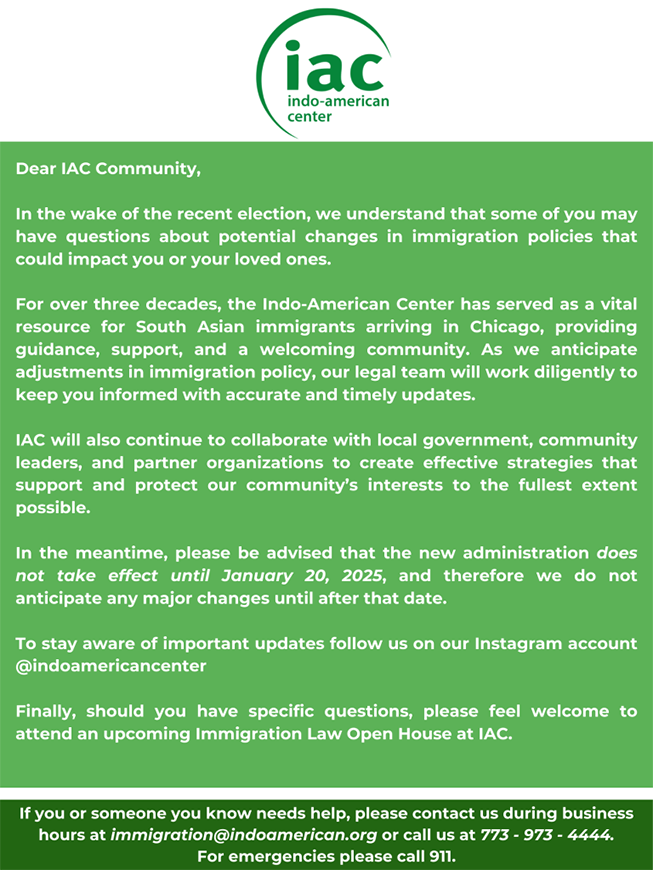
Contact us:
6328 N. California Ave.
Chicago, IL 60659
P: (773) 973-4444
E: info@indoamerican.org
Monday-Friday, 10am-5pm
INDO-AMERICAN CENTER © 2025